F E A T U R E D P R O J E C T
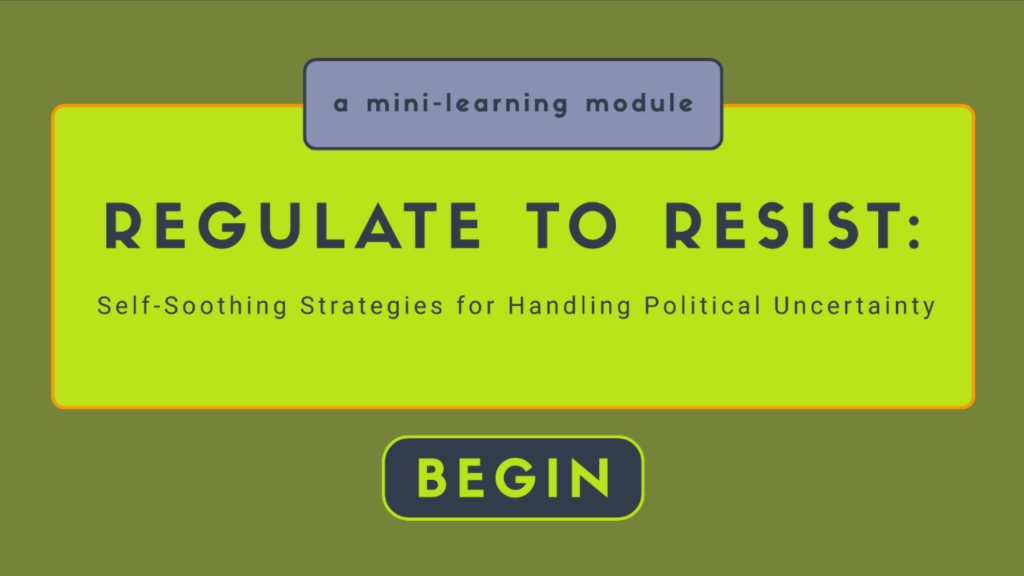
Regulating to Resist: Self-Soothing Strategies for Handling Political Uncertainty eLearning Module
Primary Tools Used:
Articulate Storyline 360 • Canva Pro • Adobe Premiere Pro • ElevenLabs
This project began with a clear instructional goal: to create a digital learning experience that introduces accessible self-regulation tools rooted in Dialectical Behavior Therapy (DBT) and Polyvagal Theory. I designed Regulate to Resist in Articulate Storyline as a short, self-paced module intended for people navigating chronic overwhelm, particularly in the face of political uncertainty, social injustice, and environmental collapse. This is a topic that is constantly on my mind as I am finding myself overwhelmed and disheartened by the current state of the world, so I channeled the anxiety into a course that I am quite proud of.
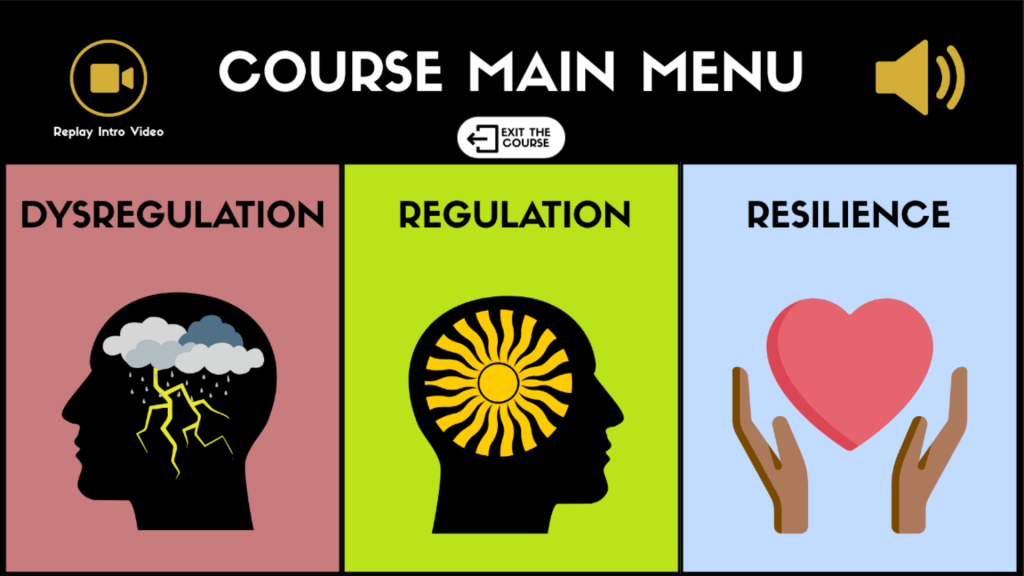
The development process emphasized both clarity and empathy. I started by mapping a three-part structure—first orienting the learner to the emotional and political context, then introducing a small number of concrete skills, and finally providing space for practice and reflection. Each scene was designed to minimize extraneous load while maximizing emotional and cognitive accessibility. Interactive slides were layered with voiceover narration, calming visual pacing, and plain language explanations that invited curiosity rather than performance. I didn’t just want to teach emotional regulation—I wanted learners to feel regulated as they moved through the module.
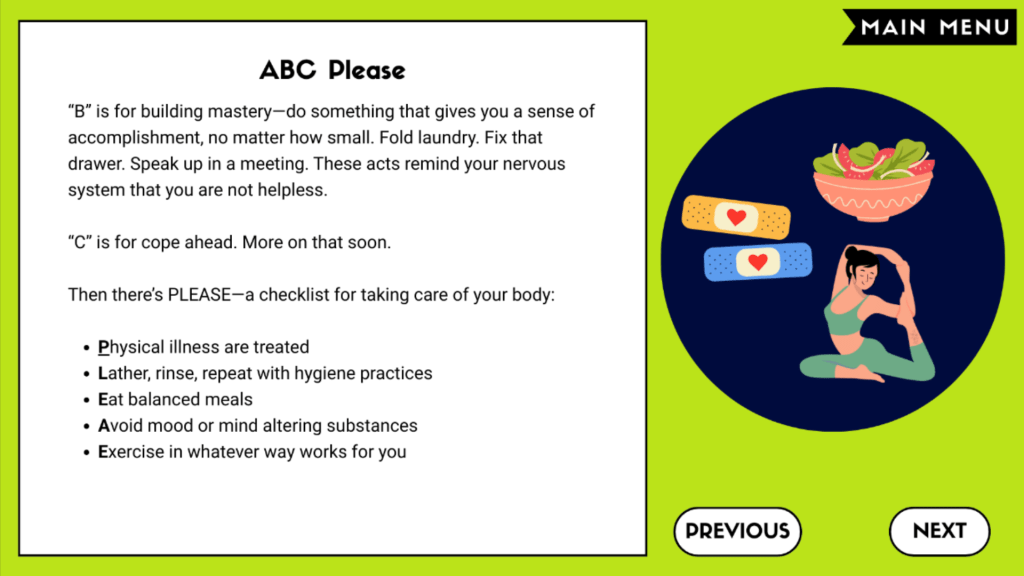
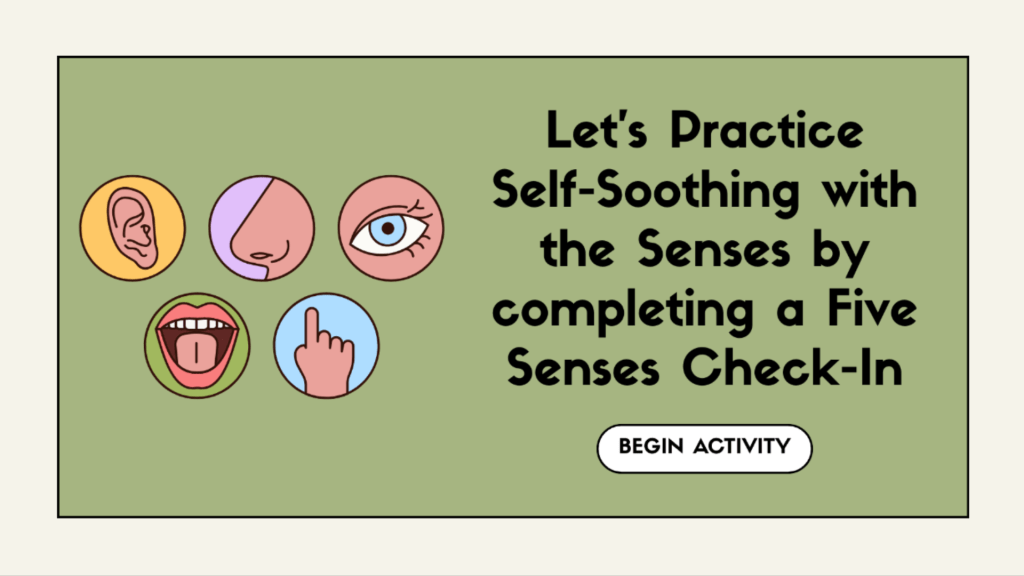
Throughout this project, I relied heavily on iterative design and learner-centered decision-making. I adapted instructional strategies from cognitive load theory, multimedia learning, and trauma-informed pedagogy to structure each interaction. For example, I used hover-over definitions and audio prompts to reduce on-screen text and support different cognitive processing preferences. Activities like the “Cope Ahead Practice” and “Accumulating Positives Practice” were turned into scenario-based reflection tools, designed to help learners apply what they were seeing in ways that felt grounded in their own lives.
Working on this course deepened my ability to translate high-level theoretical concepts into meaningful digital instruction. The entire project required fluency in both message design and modular development, from scripting and sequencing content to choosing feedback cues and interaction types. I paid special attention to alignment: making sure every piece of media, every interactive decision point, and every phrase in the narration directly supported the learning objectives. That level of intentionality is something I’ve grown more confident in with each course I design.
This project also sharpened some of my technical skills. I used a generative AI tool called Elevenlabs for the narration and really enjoyed learning how to use and integrate the tool. Because the topic deals with stress, burnout, and fear, it was essential that the tone of the module feel validating and steady, so the visual design choices were as important as the smooth delivery of the content itself. I used Canva to incorporate soft color palettes and consistent layouts across the entire course and to keep the focus on the content without creating overstimulation.
Regulate to Resist is one of the most personally meaningful projects I’ve developed, but it also reflects the rigor and clarity I bring to design and development work. It’s a strong example of my ability to integrate research, technical tools, and learner-centered thinking to build digital instruction that’s as purposeful as it is practical. The entire process of building this module reinforced how much power intentional design holds, especially when the goal is to support people in moments of stress and complexity.


OTHER RECENT PROJECTS
Non-Profit Needs Assessment: Role Reorganization at Housing Alexandria

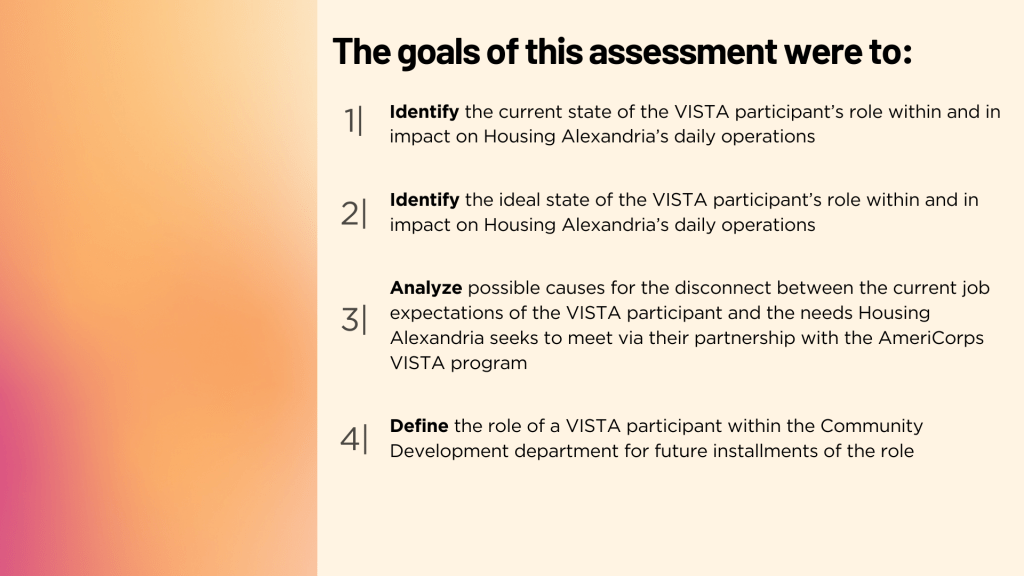

This project was my first time leading a full-scale needs assessment on my own, and it ended up being one of the most gratifying and informative learning experiences I’ve had as a designer. The needs assessment was conducted for Housing Alexandria, a nonprofit affordable housing developer here in Northern Virginia, and the focus was on reevaluating how they were structuring their AmeriCorps VISTA role. The position had previously been housed in the Resident Services department, but was currently being transitioned into the Community Development department. In addition to the reorganization, the role had historically lacked a clear or consistent definition. I was coming in as an outsider with a unique chance to listen carefully and figure out what wasn’t working and why with no preconceived ideas of what the role should look like in the organizational context.
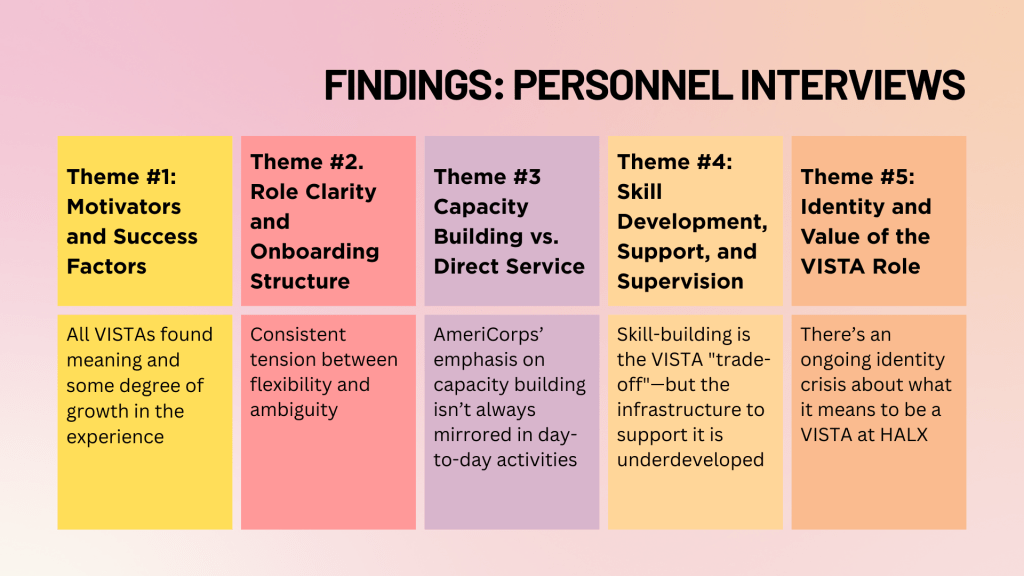
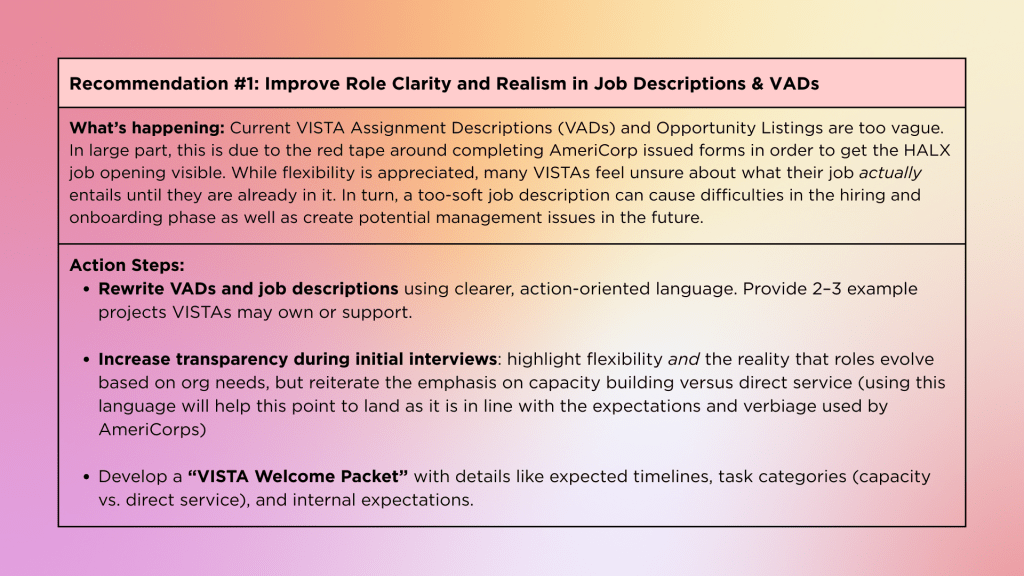
I spent weeks reviewing internal documents, talking with stakeholders, and gathering insight from people who had either served in the VISTA role or worked alongside it. I was pleased to find no shortage of information and immediate enthusiasm and support from my contact Nina Alomar. Admittedly, despite the support I had from the organization, the task of making sense of all of the information was daunting at first. I found myself having to constantly recalibrate and take one thing at a time. Once I got into a good groove, I realized the problem of the VISTA role’s shaky identity was likely a structural one. There were great people trying to do good work, but in the effort to keep the role flexible to fit an ideal candidate, ultimately the role as a piece of the organization as a whole lacked boundaries, expectations, and support leading to inefficiencies all over the place.
From a competency standpoint, this work really stretched me in terms of my technical analysis skills. Having the chance to really dig into the situation and figuring out what was going on before making any decisions about design was as challenging as it was rewarding. I had to look at the context, the people, the workflows, the pain points and map it all out without oversimplifying or fabricating connections that did not exist. I do not think I would have been able to really learn anything about human-centered analysis if it had only existed in theory based lectures, but I felt it really clicked for me through this process.
I thoroughly enjoyed every step of this project. The final steps of compiling the final report presented here helped me get infinitely more comfortable with that constant toggling between the zoomed-out view and the on-the-ground realities. Although I had always been aware on a cognitive level that the analysis portion of design work heavily requires a strong security in the unknown, change, and uncertainty, this undertaking stretched what I thought I knew about myself in those areas. I think about this project fondly and am confident that it has provided me with a much clearer vision of who I am as a designer and the kind of work I want to be doing.

 NBH Designs