Hey there, I’m Nadia!
I design learning experiences that get to the root of instructional challenges & empower learners to take pride in how their minds work.
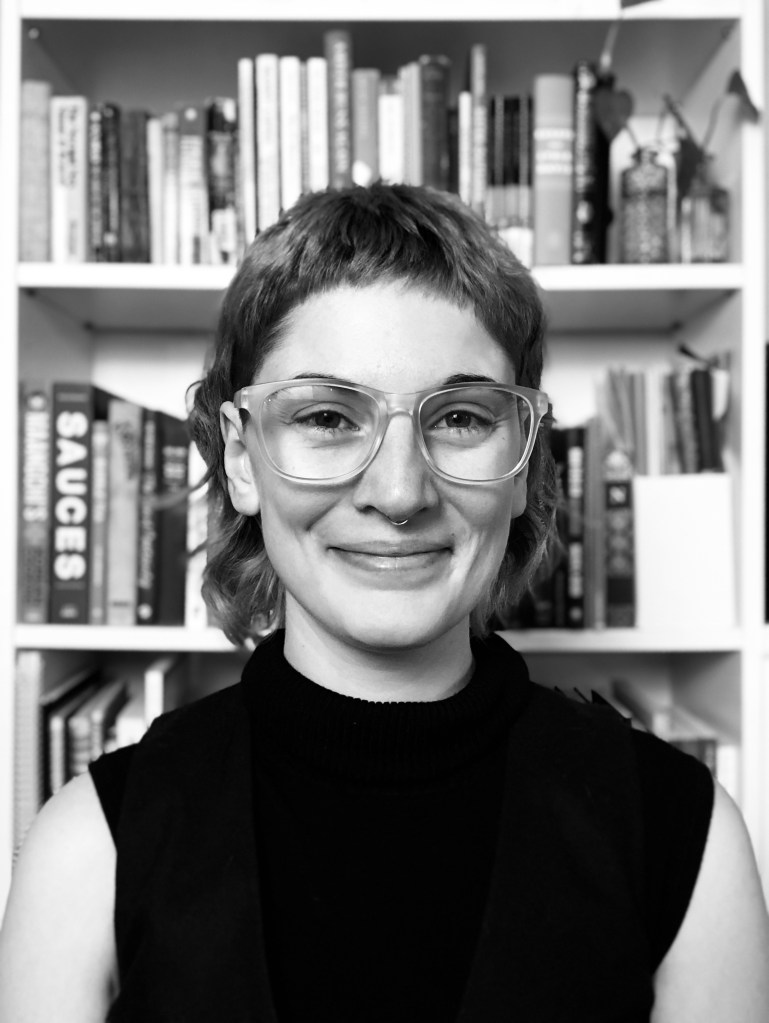
an autobiographical statement
Each time she tells the story, my mother changes at least one detail. Sometimes I am two years old, perched on the counter top and other times I am closer to just one year and plopped on the floor in the middle of the kitchen in our house in South Boston. But the punchline always remains the same: I had become convinced that the onion was an apple and I would not take no for an answer. I bit in, and I screamed. She laughs the hardest at this part:
Nadia has always been what you would call a hands-on learner.
Growing up in central Pennsylvania, the blurring between formal and informal education was as intentional as it was unavoidable. My education took place as much in the classroom—which doubled as the family room table in my elementary years—as it did in other places: fields with scattered ponds, gardens filled with bees, sharp creek beds hiding salamanders. Homeschooling allowed my mind to indulge in the constant pleasure of connection between experiences and meaning-making. Though we still followed state mandated learning standards in the majority of our coursework, the emphasis was as much on using one’s imagination as it was on critical thinking.
When I wasn’t in a tree, and sometimes even when I was, I was reading. I found comfort in worlds which bore no resemblance to my own, with a particular interest in the world of animals. I read at a feverish pace, becoming entirely consumed by the problems, adventures, and hopes of far off places.
It didn’t occur to me for some years that my environment was perhaps my most influential teacher. And because there was little separating my reality from my imagination, my environment encompassed ideas, feelings, and knowledge far outside of my physical existence.
By the end of high school, I had proudly announced that I would be a pharmacist, a humanitarian aid worker, a prima ballerina, and a travel agent. When it came time to select a major for college, the only logical path to keep all of these passions close was to study literature. The study of literature, as I see it, is a social science; a unique window into the lives and times I would never have the chance to inhabit. A way to make meaning out of anything that crossed paths with my insatiable curiosity. I was hooked. As a first year student learning rhetoric with upperclassmen, my mind came alive in a way it hadn’t before.
I knew I had chosen the right direction to start my life.
During this time, I found myself growing keenly aware of what I had not been taught. To this point, I had had no reason to doubt that the self-proclaimed “values-centered education” I received in my homeschooling circle, two years in private Christian school, and final four years in public high school had prepared me for the world I was now immersed in: one resonant with the voices of human rights activists and historians such as Audre Lorde, bell hooks, and Toni Morrison. I began pouring over the pages of hidden historical accounts like Southern Horrors: Lynch Law in All Its Phases by Ida B. Wells-Barnett and The Color of the Law: A Forgotten History of How Our Government Segregated America by Richard Rothstein.
It became abundantly clear that I—a young white person assigned female at birth from central Pennsylvania and faithfully raised under the roof of a Baptist preacher—was not supposed to have turned over this stone. But once I did, there was no going back; neither would I sit idly by while others continued to feed and be fed with a whitewashed re-telling of our country’s true identity.
◇ ◇
This realization sparked a vigorous reorganization of my own values, an unmistakable turning point. After sifting through hand-me-downs, I was able to stitch together what would become my guiding principles: Education is a right, not a privilege. Education and instruction are political. The community remembers and always knows best. The only way truth can be preserved is through the individual commitment to curiosity, willingness to face opposition, and belief that the truth will set us all free.
My pursuit of these values led me to the Masters of Education in Learning Design and Technology program at the University of Georgia. My initial goal upon entering the program was to acquire new skills in an area of expertise that aligned both with my values and natural tendencies in order to forge a solid career path. But when I discovered the essence and principles behind instructional design, I was captivated. Quickly, this goal began morphing into something more.
Early on in the program, I was exposed to the concept of informal learning: intentionally crafted instructional experiences that are delivered to the “learner” in subtle ways. In other words, creating learning experiences was not all about a formulaic fully interactive Storyline 360 eLearning course.
Instead, it seemed to me that there is as much importance for formal learning as there is for informal learning to be created by individuals with theoretical backgrounds and delivery skills. I decided that informal learning would be my focus and jumped at every opportunity to practice the dynamic skills required to successfully achieve transfer of knowledge in a less formal capacity.
Surprisingly, the first opportunity came in the summer of 2024 which was only my second semester in the program. I was enrolled in a video production course that introduced us to a wide variety of skills required for creating successful instructional video content. I felt like I got to play in this class which enhanced my ability to focus and create meaningful work. The final assignment for this course was to film, edit, and produce an instructional video on a topic of our choice. As I was still relatively green in my theoretical knowledge at this point, I decided to stick to a topic I knew inside and out: cooking.
While the topic of the project itself was not radical, I began to flex muscles I didn’t know I had. In order to deliver something that made sense, I spent countless hours scripting out the voiceover, careful to consider what someone who has never been interested in cooking or perhaps
even believed themselves incapable of doing so would need to hear to follow instructions. This is where I began to understand the importance of centering empathy in instructional design. Though I had never considered the role of empathy in formal instructional material, in an informal learning setting such as a how-to cooking video, it felt impossible to continue without thinking about my intended audience as a collection of real, complex individuals.
One of the biggest lessons I’d learned from the authors in my undergraduate study was that it takes real humility to put yourself in the middle of someone else’s story, someone else’s reality, and say “I do not know anything about this and I am willing to learn without interrupting you when my reality is feeling threatened. Please, tell me everything.”
Without this willingness, you are going to at best miss the point and at worst, contribute to the ongoing cycle of knowledge being buried beneath feeling. Instructional design, I came to find out, followed the same rule.
Without empathy, your design will fall flat and potentially alienate those who you sought to reach.
◇ ◇
As I neared the end of my program, I felt that it was time for another serious sit down with my values. What will I do with what I know? How has this program changed who I am as a person and as a professional? What will I give back?
My focus is aimed at continuing to contribute to the efforts and capacity of local, community based organizations. I plan to use the valuable
knowledge gained from this program and from my own life experiences to partner with nonprofit organizations at all stages of their lifecycle. Whether by conducting a needs assessment for a new role at an affordable housing non-profit or creating microlearning videos for grassroots political campaigns, I plan to sow back into the
ground I came from. The dirt that made me, me.
That’s one thing you don’t forget when you grew up alongside trees: what is here may only be here until the end of the day, but you can sleep soundly knowing that under the earth there is constant movement.
Something new will be reaching for the light in no time.
 NBH Designs