
Artifact 1: “Let’s Talk Trash” Storyline Course Design Document
Created for EDIT 7520E: Online Teaching & Learning
This course was born out of two things: a personal frustration with how overwhelming it can feel to “do the right thing” for the environment and a professional curiosity about how instructional design might help people feel more capable at the face of seemingly overwhelming tasks such as social responsibility. Let’s Talk Trash is an asynchronous online learning experience that introduces adult learners to the real impact of household food waste and walks them through how to reduce it, with an emphasis on making the practice of composting more accessible to the average person. While the topic itself might be niche, designing this course let me flex a wide range of foundational instructional design skills fairly early on.
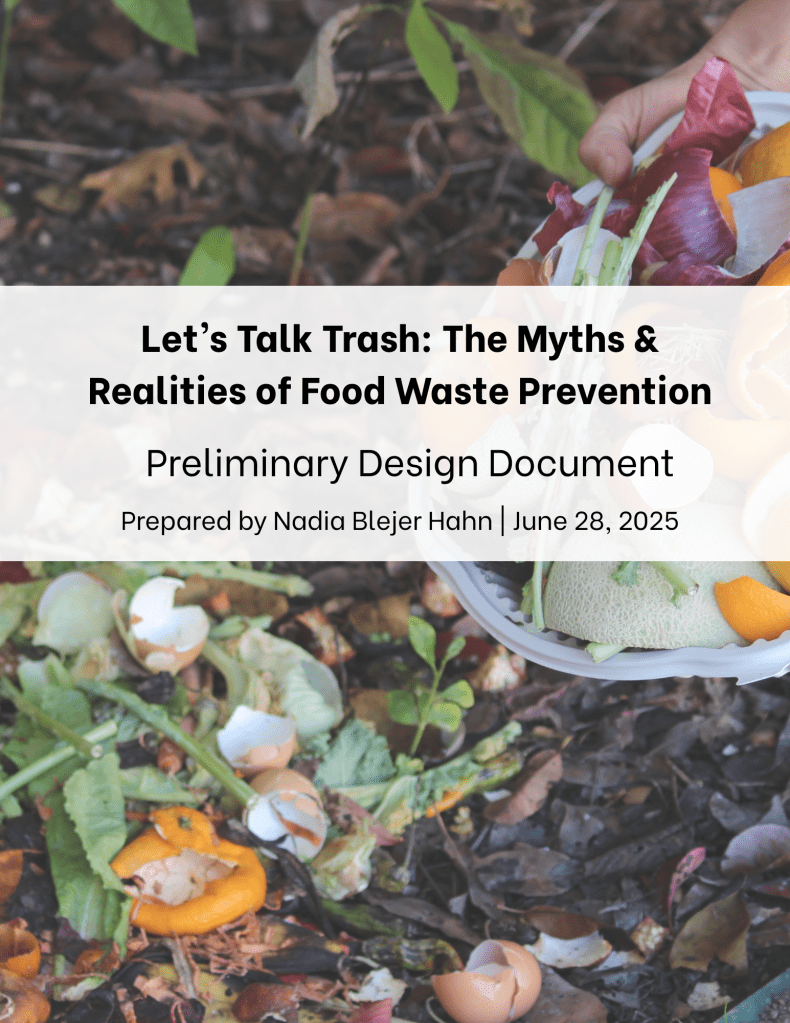
Click on the Above Image to View This Artifact
The instructional problem was informed by an anecdotal truth: most people aren’t composting, not because they don’t care, but because they don’t know where to start. But the more I looked into this hunch, it seemed that it was more likely that misinformation about what food waste actually is and the problems it is responsible for was the root cause of inaction. I started by analyzing existing research and data on food waste behavior and paired it with an audience analysis focused on everyday adults living in urban areas. These are people who may be renters without backyards (like myself), who scroll past climate news feeling helpless, and who need small, manageable steps not more lectures about just how bad it is.
From there, I wrote learning objectives that I hoped were both measurable and motivating. I wanted learners to walk away not just knowing facts about methane gas or composting regulations, but feeling like they could actually do something such as making a personal action plan that works in their real life, whether they’re composting in a city apartment or just learning to store food more mindfully.
Each of the three modules includes interactive elements like games, scenario-based microlearning videos, and application-based assessments.
I deliberately avoided traditional testing in favor of more reflective, creative tasks. For example, at one point learners are prompted to write a blog post about a food waste myth they once believed. My goal was to give learners multiple entry points and ways to engage that felt personal and truly meaningful rather than theoretical. This was particularly important given the reality that many people arrive at environmental education with mixed feelings like guilt, skepticism, or even burnout.
I view the development of this course as one of the clearest and most effective instances I was given in my program of study to really hone in on my professional foundations skills. I applied written communication skills to create a clear and accessible syllabus, scaffolded instructional materials, and informal content that met learners where they are. I also designed visual learning elements like infographics and animated microlearning videos, allowing me to practice effective visual communication for diverse learners. The tone of the course—approachable, affirming, and data-informed—reflects my ability to adapt communication styles to suit audience needs while maintaining clarity and motivation. Ultimately, Let’s Talk Trash gave me the chance to embody the spirit of the Foundations domain and I am proud of what I was able to create with such little previous practice using these skills in the instructional design space.
⬨⬨⬨
Artifact 2: Review of Literature
Created for EDIT 6900E: Research Methods in Instructional Technology
At its core, a Review of Literature (ROL) is about making sense of a crowded conversation. The goal is to gather, examine, and synthesize as much existing research on a topic as possible. This in itself was a bit of a stretch for me as a writer as I had not had much experience with the structure of a ROL and that presented a learning curve. When choosing a topic for this paper, I kept coming across interesting articles related to Cognitive Load Theory (CLT) and decided to follow that curiosity. As I continued to read, the sense of resonance with the ideas posited by scholars began to grow, not just in a “I like this theory” sense from more of a personal “I have absolutely experienced cognitive overload as a neurodivergent learner and need to know everything about this as I possibly can” angle.
Click on the Above Image to View This Artifact
From the start, it was clear to me that I was passionate about this topic, though I had never had the language for it before. That personal interest helped me frame the process of writing this paper not just as an exercise in foundational skills such as writing and research, but also those related to shaping and developing an identity as a designer. I found my source in a bunch of different places, pulling studies from educational psychology, learning science, and instructional tech. I paid attention to how researchers defined and explored intrinsic, extraneous, and germane load, but also how those ideas mapped onto real-world design challenges. It was validating, in a personal way, to read the science beneath unclear navigation, clunky visuals, irrelevant content contributing to mental distress and overwhelm after a lifetime of believing that I just wasn’t “able” to keep up with certain kinds of information. The research gave language and structure to things I’d sensed intuitively, and the writing process helped me process and internalize it all.
The act of writing the paper shaped my learning just as much as the reading did. When I get excited, I tend to skip important connecting phrases and ideas, especially when writing. The
task of writing this review, however, forced me (in a good way) to closely consider how to communicate complex concepts presented in the research in a way that could make sense to someone else. I rewrote sections several times, not because the facts changed, but because I kept finding sharper ways to explain them. That process significantly helped me become more intentional about how I communicate not just in writing, but in design itself. What’s the clearest path from idea to understanding? Where might someone get overwhelmed? How can I reduce the noise?
I really enjoyed this assignment and view the process of putting it together as an incredibly informative experience. I discovered how much I personally enjoy blending theory and practice both in my writing and my instructional designs. Since writing this paper, I have found myself reading scholarly articles about CLT and related learning theories simply for the pleasure of it. I believe that what we do when no one is watching (neither a professor nor a stakeholder) has the potential to make the most impact on our identity as designers.
 NBH Designs